
Service
AI literacy enforcement starts 2 August 2026. Are you covered?
The Article 4 AI literacy obligation has applied since February 2025 — but per the European Commission's own AI Literacy Q&A, supervision and enforcement begin on 2 August 2026. The May 2026 Digital Omnibus softened the wording (organisations must now “support the development of” AI literacy rather than “ensure” it), but it did not move that enforcement date.
The obligation applies to every employer using AI — including anyone using Teams, Copilot, ChatGPT, or AI recruitment and scheduling tools. Acuity helps you assess your exposure, design a proportionate programme, and document compliance. In weeks, not months.
What Article 4 actually requires
Article 4 of the EU AI Act imposes a straightforward but deceptively demanding obligation: organisations that deploy or use AI systems must support the development of a sufficient level of AI literacy among their staff — proportionate to their role and the risks involved. (The original text said “ensure”; the May 2026 Digital Omnibus agreement softened the wording to “support the development of” — a real change in standard, but not a repeal.)
The obligation has applied since February 2, 2025, and — per the European Commission's AI Literacy Q&A — supervision and enforcement begin on 2 August 2026. Organisations that have not yet assessed their AI literacy position are already behind, and from August a supervisor can ask them to prove otherwise.
The scope is broader than most employers realise. If your organisation uses Microsoft Teams with Copilot features, ChatGPT, AI-assisted recruitment or scheduling software, automated customer communications, or any tool where AI shapes decisions, Article 4 applies. The law does not distinguish between purpose-built AI products and AI features embedded in mainstream enterprise software.
“Sufficient” is deliberately undefined — the Act requires organisations to make a reasonable, documented determination based on their specific context. That determination must reflect the role each employee performs and the risk level of the AI systems they interact with. A one-size-fits-all e-learning module does not satisfy the obligation.
If you can't show what you've done, you haven't done it
Ireland's AI Office of Ireland will be fully operational from August 1, 2026, with powers to inspect compliance, request documentation, and impose sanctions. The Central Bank of Ireland, HPRA, and Data Protection Commission are designated National Competent Authorities for AI compliance within their respective sectors — inspections will follow existing sectoral relationships.
Regulatory inspection of AI literacy compliance is documentation-led. An inspector will ask to see your role inventory, your AI touchpoint mapping, your risk assessment, and your training records. Saying that staff completed a training module is not sufficient — you need evidence that the training was designed proportionately to role and risk, and that it was actually delivered.
SMEs face the same obligation. Proportionality means the programme can be lighter — but the documentation requirement is the same. If you cannot demonstrate what you have done, the regulatory presumption is that you have done nothing.
What Acuity delivers
Our AI literacy programme is a structured engagement designed to produce a defensible compliance position — not a training catalogue or a generic checklist.
- AI literacy gap assessment: inventory roles, map AI touchpoints, identify risk levels
- Proportionate programme design: a role-calibrated framework, not a generic training course
- Compliance documentation: evidence that would withstand regulatory scrutiny from the AI Office
- Ongoing advisory: as regulatory expectations develop through 2026 and beyond
The engagement is fixed-scope and typically completed in two to four weeks. The output is yours to keep — a compliance file that can be produced to a regulator, shared with a board, or used as the foundation for ongoing programme development.
Productised offer
The AI Literacy Evidence Pack
A readiness sprint built for one purpose: when a competent authority asks how you support AI literacy, you hand over a file instead of an explanation. The pack includes:
- Role-calibrated AI literacy training, delivered to your staff
- Attendance and completion records, tied to the role inventory
- An AI use and literacy policy, proportionate to your risk profile
- The evidence file an authority would ask for: role inventory, AI touchpoint map, risk rationale, and programme design record
Fixed-fee, scoped in a 30-minute call.
Sectors served
Article 4 applies across all industries. Acuity has particular experience with organisations where AI use intersects with professional obligations, regulated functions, or high public accountability.
- —Professional services — law firms, accountancies, consultancies
- —Financial services and insurance
- —Healthcare and life sciences
- —State bodies and publicly accountable organisations
- —Technology and SaaS companies
Common questions
Is AI literacy training mandatory for Irish employees under the EU AI Act?
Yes. Article 4 of the EU AI Act has applied since February 2, 2025, and requires all organisations operating in the EU — including Irish employers — to support the development of a sufficient level of AI literacy among staff who work with AI systems (the May 2026 Digital Omnibus softened the original “ensure” wording, but the obligation stands). It is a binding legal obligation, and per the European Commission's AI Literacy Q&A its supervision and enforcement begin on 2 August 2026. The scope is broad: any organisation using AI tools, including Microsoft Copilot, ChatGPT, AI-assisted scheduling, recruitment, or customer service tools, is in scope.
What does sufficient AI literacy mean in practice?
The EU AI Act does not define sufficient — that determination is left to each organisation. The standard is proportionality: literacy must be sufficient relative to the role the employee performs and the risk level of the AI systems they interact with. A finance director using AI for forecasting has a different literacy requirement to a receptionist using an AI scheduling tool. In practice, organisations must map roles to AI touchpoints, assess risk levels, determine appropriate literacy thresholds, and implement training that meets those thresholds — then document all of it.
Does Article 4 apply to SMEs in Ireland?
Yes. Article 4 applies to all organisations using AI systems in the EU, regardless of size. There is no SME exemption. The proportionality principle means a smaller organisation with lower-risk AI use will have a lighter compliance burden than a large enterprise deploying AI in high-stakes decisions — but the obligation to assess and document AI literacy exists for every employer using AI in any material way.
How do I document AI literacy compliance for the AI Office?
Ireland's AI Office of Ireland will be operational from August 1, 2026, coordinating 15 sectoral competent authorities with powers to inspect compliance and request documentation — and supervision of the AI literacy obligation itself begins on 2 August 2026. The EU AI Act's general non-compliance penalty ceiling is €15 million or 3% of worldwide annual turnover. Documentation of AI literacy compliance should include: a role inventory with AI touchpoints identified, a risk assessment for each AI-enabled function, a record of training delivered and to whom, and evidence of how your programme was designed to be proportionate. Acuity's programme produces all of this documentation as a deliverable.
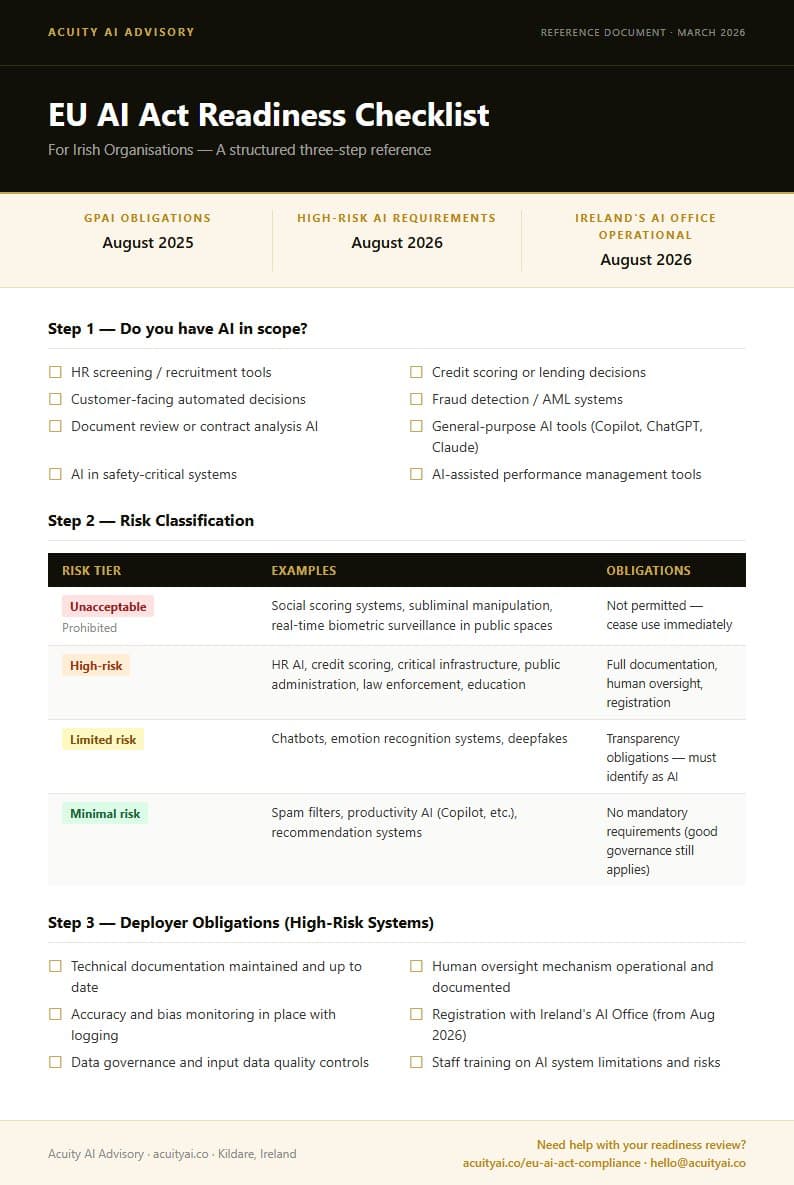
Free download
AI Literacy Compliance Checklist
A practical checklist for Irish employers assessing their Article 4 obligations and documentation requirements under the EU AI Act.
No spam. Unsubscribe at any time.
Request an AI Literacy Assessment
Fixed-scope. Typically completed in two to four weeks. Produces a compliance file ready for regulatory scrutiny.