
AI Productivity Workshop · Ireland
Diagnosed before tools. Measured after.
Half-day or full-day. Pre-session diagnostic. Sector-customised scenarios. Written post-session analysis. The workshop organisations use when they need behaviour to change — not awareness to rise.
Delivered to leadership cohorts at Ireland's largest professional body for solicitors, a national insurance group, a global pharma multinational and a national postal authority. All training programmes →
Request a workshop proposal
30 – 40%
of structured leadership time, consistently misallocated to low-value activity across cohorts we have run. Meetings that produce no decisions. Tasks that don't map to stated priorities. Reactive work crowding out proactive work. Not a character or discipline issue — a structural issue created by calendar culture, notification environments and poorly designed workflows. The workshop surfaces it. The Cognitive Operating Plan addresses it.
How a workshop actually runs
Three phases. Most providers skip two of them.
Before
Pre-session diagnostic + M365 provisioning check
Two weeks out, participants complete a short survey: how they work today, where the friction is, what they have tried, what confidence looks like. We analyse the data, and we check which M365 features your IT team has actually provisioned — because Copilot demos on top of features people don't have is one of the cleanest reasons sessions fail. By the time we walk in the door, we know what will land and what won't.
During
Sector-customised scenarios, not a tool tour
Half-day or full-day. Mixed-proficiency teams, with the manager in the room — because follow-through has social weight when everyone in the team made the same commitments together. We open with a structured view of how leadership time is actually being spent, walk through the five diagnostic dimensions, then run scenario work built specifically from the pre-session data. Finance does Finance. Operations does Operations. Tools are introduced as solutions to diagnosed problems, not as the starting point.
After
Written analysis + Cognitive Operating Plan
Within a week we deliver a written post-session analysis — where people got stuck, what generated the most questions, what the data says about where to go next, recommended interventions. Every participant leaves with a personalised Cognitive Operating Plan and a 90-day implementation calendar. Where appropriate, bespoke supplementary assets follow: prompt libraries, tool comparison guides, cheatsheets. Multi-day engagements include 90 days of implementation support.
Five diagnostic dimensions
What we baseline before we train.
Dimension 1
Attention management & cognitive load
How interruptions, notifications and context-switching compound through the day, and where attention is being depleted before strategic work begins.
Dimension 2
Meeting compression & calendar efficiency
Where calendar density is producing meetings without decisions, and where the time freed by AI is being reabsorbed into more meetings rather than redeployed.
Dimension 3
Cognitive peaks & deep work scheduling
When the brain is actually capable of strategic work for this individual, versus when the calendar currently places it.
Dimension 4
Priority drift identification
Where stated priorities and lived calendar diverge — usually quietly, over weeks, in ways nobody notices until it shows up in performance.
Dimension 5
Interruption patterns & recovery time
How long it takes to return to focus after each kind of interruption, and which interruptions cost most relative to their stated importance.
What participants leave with
Not a list of tools to try. A plan built from their own data.
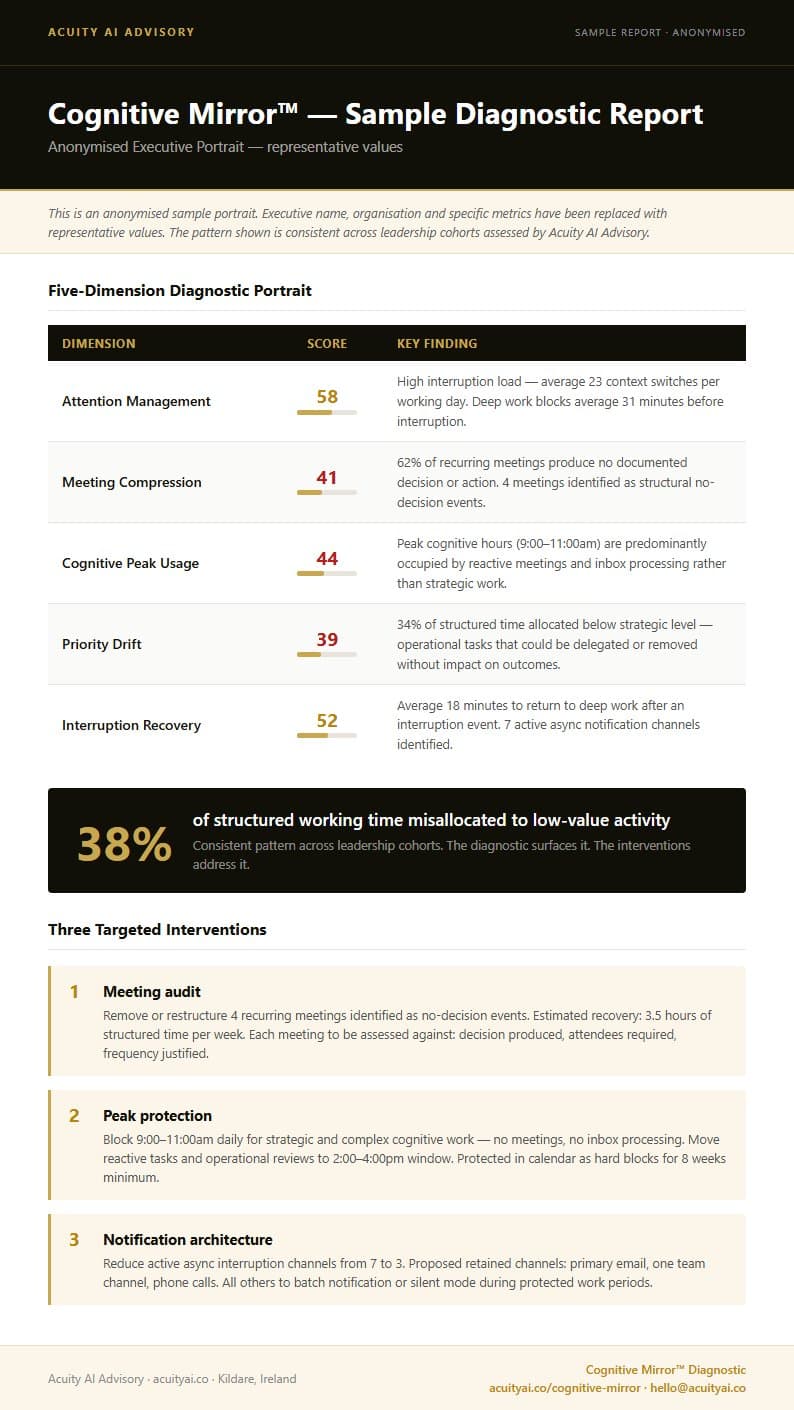
Free download
See a sample Cognitive Mirror report
What does a leadership portrait actually look like across the five dimensions? This anonymised report shows the depth of analysis — including the 30–40% misallocation pattern at the individual level.
No spam. Unsubscribe at any time.
Common questions
Six things people ask before booking.
What is a Cognitive Operating Plan?
A Cognitive Operating Plan is a personalised working framework developed for each participant based on their diagnostic results. It maps their optimal focus periods, defines their meeting load threshold, identifies the categories of work where they are most and least effective, and sets a 90-day implementation calendar for changing specific working patterns. It is the output participants leave with — not a generic set of productivity tips, but a structured plan built from their own data.
How is this workshop different from a standard AI tools session?
Most AI productivity workshops demonstrate tools. This one starts with a pre-session diagnostic of how each participant currently works, and a check of which Microsoft 365 features your IT team has actually provisioned to them. Working patterns are baselined using M365 data prior to the session and tracked after. That means the outcome is measurable — not a matter of participant opinion. Tools, where relevant, are introduced as solutions to diagnosed problems, not as the starting point.
How long is the workshop and how many people can attend?
Half-day and full-day formats. Leadership cohorts of six to twenty participants. Larger organisations run multiple cohorts to build team-level insight in addition to individual outputs. Sessions are customised per sector — the diagnostic dimensions and scenario work are adapted to your industry context, using data from the pre-session survey so the scenarios are ready before we arrive.
What does the 30–40% time misallocation finding mean in practice?
Across leadership cohorts, a consistent pattern emerges: 30 to 40 percent of structured working time is allocated to low-value activity — meetings that produce no decisions, tasks that do not map to strategic priorities, reactive work that crowds out proactive work. This is not a character or discipline issue. It is a structural issue created by calendar culture, notification environments and poorly designed workflows. The workshop surfaces this pattern at the individual level and gives participants a framework to address it.
What do you mean by sector-customised?
Before every session we run a pre-session survey with participants and analyse the data. By the time we arrive, we know which tools your people have access to, where confidence is lowest, which workflows are causing the most friction, and which scenarios will land for your sector. The scenarios we run in your Finance team are built for Finance. The ones we run in your Legal team are built for Legal. Generic slide decks stay at home.
What happens after the session?
Within a week we deliver a written post-session analysis — what the data showed, where people got stuck, what generated the most questions, what the data tells us about where to go next. Where appropriate we provide bespoke supplementary assets: tool comparison guides, video recommendations, cheatsheets. Multi-day engagements include 90 days of post-programme implementation support. The work does not stop when the room empties.
Request a workshop proposal.
Delivered on-site across Ireland. Priced per cohort. A 30-minute scoping call tells us about your team, your tools and your sector — and tells you whether the workshop would move the needle for you.